What an Agenda Can Tell You Before a Public Meeting
Learn how a public meeting agenda signals the order, scope and papers behind a decision, so you can prepare informed questions without assuming its outcome.
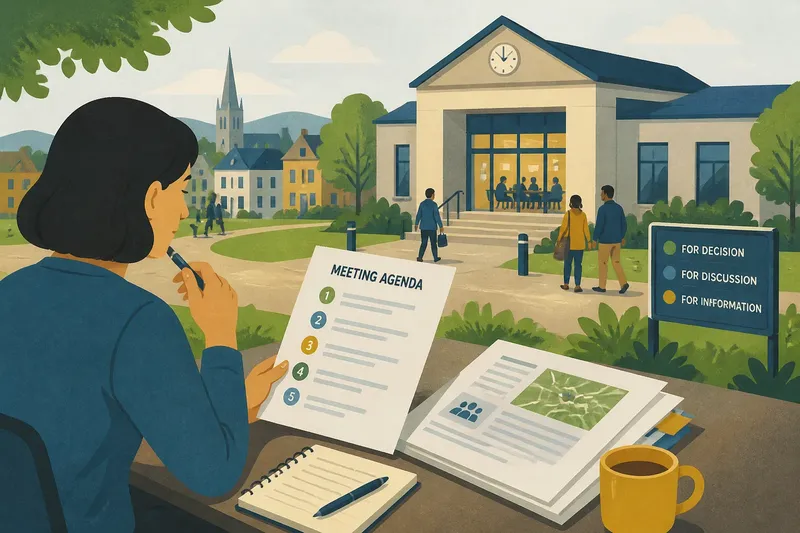
You open a council agenda over breakfast and spot a heading about a proposed change to a local service. The public meeting agenda can tell you what officials expect to consider, where the item sits in the meeting and which papers may explain it. It cannot, by itself, tell you what the eventual decision will be.
Read it as a map of the meeting’s planned business, not a transcript of what happened or a promise about what will happen next. A useful first pass is to notice the order, translate the item descriptions into plain language and follow the links to supporting papers.
What does the order of items tell you?
Agenda order tells you the sequence in which business is scheduled, and can hint at how the meeting is organised. Routine formalities may come first, followed by reports, proposals and other substantive items; the exact pattern depends on the institution and its rules.
Look for headings such as “apologies”, “declarations of interest”, “minutes”, “public questions”, “reports” or “other business”. These indicate different kinds of activity. Approval of previous minutes, for example, is not the same as considering a new policy proposal. A report may be presented for information, while a separate motion or recommendation may invite action.
Placement can help you plan your attention, but it is not a reliable clock. A meeting may spend little time on one item and much longer on another. Items can be taken out of order, deferred or withdrawn, depending on the meeting’s procedures and circumstances. An agenda therefore gives you a planned sequence rather than a schedule you can treat as fixed.
Pay attention to whether an item appears under a section marked “for decision”, “for discussion” or “for information”. Those labels can indicate the intended purpose of the item, but check the wording of the report and any recommendations too. A report presented for information may still prompt questions or further action; a decision item may ask members to choose between options rather than accept a single proposal.
How should you read an item description?
An item description is a short signpost, not the full case for or against a proposal. Read its main noun and verb: is the meeting being asked to approve, note, review, receive or consider something? Those words point to different kinds of business.
“To receive the annual report” generally signals that members will be presented with a document; “to approve the revised policy” indicates a request for a decision. “To consider options for…” leaves the outcome more open. Even so, the description alone may not say what options are available, who prepared the proposal or what the implications are. The supporting paper is usually where that detail appears.
Watch for language that makes a proposal sound settled before members have considered it. A heading might name a “new parking scheme”, while the report asks the committee only to review possible approaches. Or the item may be titled “service changes” without identifying what is changing. Treat the title as a search clue: follow it into the paper before drawing conclusions.
Names of departments, committees and locations can also help you identify the scope. A report about a particular site may be a narrow operational matter rather than a decision covering an entire area. Conversely, a short title such as “budget update” may refer to choices affecting several services. Check the paper’s stated purpose, recommendations and appendices to understand the actual reach.
What should you look for in the supporting papers?
Supporting papers turn a compressed agenda line into something you can assess. Start with the report’s purpose and recommendations, then check the background, options and appendices for the reasoning behind them.
- Purpose: Find out why the report is before the meeting and what members are being asked to do.
- Recommendation: Note the proposed action, including any wording such as “approve”, “agree in principle” or “refer back”.
- Options: See whether alternatives are set out and what reasons the report gives for preferring one.
- Effects: Look for sections on residents, services, access, costs, risks or implementation, where relevant to the proposal.
- Appendices: Check for maps, draft policies, consultation summaries or technical material cited in the main report.
- Authorship and date: Identify the responsible team or officer and when the paper was prepared, so you can place its information in context.
Not every paper uses the same headings, and some attachments may be separate files. If a report refers to a map or analysis that you cannot locate, note the gap rather than assuming the material does not exist. Some material may also be withheld from a public pack under applicable rules; the agenda may identify that a section is private or confidential without reproducing its contents.
Imagine you see an agenda item titled “Neighbourhood library options”, with a report recommending that members approve a preferred location. You could note that the paper presents the choice as a recommendation, check whether it compares other sites, and mark any map or access information you want clarified. That preparation can help you ask a focused question; it does not establish which option members will choose.
How can you tell whether the meeting is being asked to decide?
Look for a clear request to the meeting, often set out in a recommendation or proposed resolution. Phrases such as “the committee is recommended to approve” or “members are asked to determine” suggest that a decision is intended. A request to “note the report” ordinarily signals a different purpose.
Then check which body is named as the decision-maker. A report may be discussed by one committee but require approval from a different body, or it may ask members only to advise or recommend a course of action. The relevant wording may distinguish between a decision made at this meeting and a recommendation passed on for later consideration.
The agenda may also list a decision item without showing every possible outcome. Members might accept the recommendation, amend it, defer the matter or ask for more information, subject to their powers and procedures. A paper’s recommended option is evidence of what its author is asking for, not proof that the meeting will agree.
For a clear reading, separate three things in your notes: what the report recommends, what the meeting is authorised to decide, and what the agenda says is scheduled. Keeping those points apart prevents a proposal from being mistaken for an adopted decision.
What can you infer from the order, wording and papers?
You can infer the intended route through the meeting’s business and identify where a particular issue sits within it. The agenda may show that a proposal is scheduled for discussion or decision, and its papers may explain the case being put to members. These clues help you understand what is on the table.
You cannot infer from the agenda alone that members support the proposal, that a vote will take place, or that the listed recommendation will be adopted. Nor does a heading necessarily capture every concern raised by residents or every alternative considered. The meeting record, later decision notice or published minutes may give a fuller account of what happened, though each serves a different purpose.
Think of the agenda like a parcel label: it tells you what has been sent and where it is meant to go, but not what is inside every document or how the recipient will respond. The supporting papers open up more of the contents; the meeting itself determines what discussion and action follow.
What questions should you ask while reading a public meeting agenda?
Does “for information” mean no decision can follow?
Not necessarily: it describes the item’s stated purpose, but discussion can still lead to questions or further work. Check the report and the meeting’s procedures before deciding what action is possible.
Does a recommendation mean the decision is already made?
No. A recommendation is a proposed course of action, usually put forward by the report’s author or responsible team. The authorised members may accept it, change it, defer it or choose another permitted response.
Why are some agenda papers missing or marked private?
A paper may be published separately, added later or treated as confidential under the relevant rules. Look for a note explaining how to access it or why it is not in the public pack; the rules and available review routes vary by institution.
What if the agenda title and report seem to say different things?
Use the report’s purpose and recommendations to understand the request, and note the mismatch rather than assuming one wording settles the matter. You can ask the relevant clerk or public contact which description reflects the business scheduled.
How can you prepare a useful question from the agenda?
Start with a point the papers leave unclear, then ask for the information needed to understand the proposed action. A question such as “What factors were used to compare the locations in the appendix?” is more focused than a broad objection because it refers to material members have before them.
If you plan to attend or submit a question, check the meeting’s own arrangements for public participation, deadlines and speaking rules. Those details may appear in a separate notice or on the institution’s meeting page, rather than in the agenda itself. Where the right interpretation depends on the institution’s standing orders, the paper’s instructions or local rules, consult the relevant official source.
Keep a small note of the item number, report title and the specific passage you are asking about. If the papers give a recommendation but do not explain an alternative, ask where that comparison can be found. If the agenda lists a decision but the report names another body, ask which body has authority to act. These questions help make your concern precise without assuming an answer.
A public meeting agenda is most useful when you read it as a record of planned business: sequence, purpose and the papers put before members. The phrase public meeting agenda is a good starting point for finding what is scheduled, but the report and the eventual meeting record answer different questions. Save the agenda alongside the papers, then check the published outcome afterwards; that simple habit lets you compare what was proposed with what the institution actually recorded.