The Open Invitation Myth: Why Access Takes More Than an Invite
Public consultation access takes more than an invitation. Learn how to spot barriers in timing, language, location and response options before people are left out.
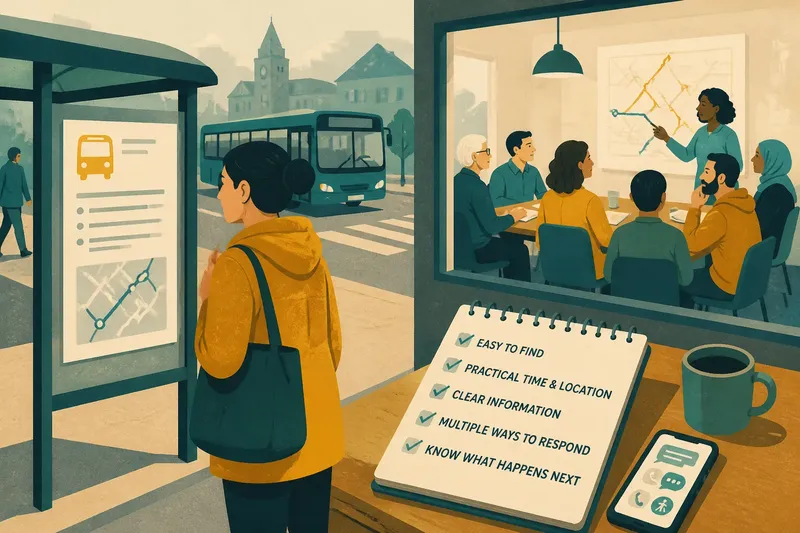
A neighbour sees a notice for a town-centre consultation while waiting for the bus, but the meeting is already under way by the time she finishes work. The invitation is public; participation is not yet practical. Public consultation access depends on whether people can understand the opportunity, reach it and contribute in a usable way.
An open invitation can be a necessary first move, but it does not by itself remove barriers. A notice may be widely circulated and still leave out people who cannot attend at the stated time, cannot follow its language or cannot tell what will happen to their comments. The useful question is not simply, “Was everyone invited?” It is, “Could the people affected take part on workable terms?”
Why doesn’t a public invitation reach everyone?
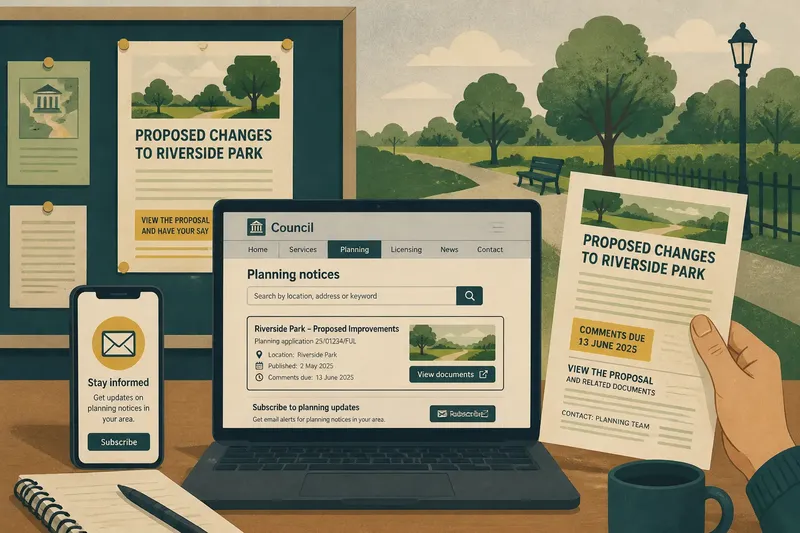
Public bodies often treat publication as the same thing as communication. They post a notice on a website, put a copy in a library, or send it through an email list and assume that people concerned will see it. Each channel reaches some readers, but none reaches everyone. People may not use the relevant website, hear about a meeting through local networks, or recognise that a formal notice concerns their street, service or community.
There is also a difference between making information available and making it findable. A notice buried under several layers of a council site may technically be public but difficult to locate. Unclear titles such as “Community engagement opportunity” tell a reader less than a heading that names the place, proposal and decision at issue.
What to try: Make the invitation specific enough to recognise at a glance. Say what is being discussed, which places or services it affects, who is organising the event, and where a person can get the full details. Share it through more than one relevant channel, including local organisations that already communicate with the people concerned. Avoid relying on a single noticeboard or mailing list as the whole outreach plan.
What if the timing or location makes attendance difficult?
A meeting can be open in principle and still be out of reach in practice. A weekday session may conflict with shifts, caring responsibilities, school runs or public transport schedules. A building may be familiar to organisers but unfamiliar to residents; its entrance may be hard to find, or the room may not work for someone using a mobility aid. Moving the event online does not automatically solve the problem: a person may lack a suitable device, reliable connection, private space or confidence with the platform.
These barriers are easy to miss if organisers think only about the room booking or the meeting link. Access is a chain: a person needs to find the event, get there or connect, take part, and leave knowing what happens next. A broken link in that chain can make the invitation unusable.
What to try: Check the venue, route, start time and online arrangements from the attendee’s point of view. Offer a clear contact for access needs, explain the available formats, and consider whether a second session or a written contribution route would reach people who cannot attend. If there is a remote option, state whether participants can speak, use chat, or submit comments another way; “online meeting” alone does not answer that.
Can people understand what they are being asked to discuss?
Consultation material can be technically complete yet hard to use. An invitation might refer to a “service redesign” or “preferred option” without explaining what is changing, what is still undecided, or which parts of the proposal are open to comment. Acronyms and procedural language add another hurdle. Readers then have to guess whether the event is a genuine opportunity to influence a choice or a presentation of a decision already made.
Plain language does not mean stripping out important detail. It means giving readers a clear route through it: a short explanation of the issue, the choices under consideration, the constraints, and the question organisers want answered. Maps, labelled diagrams or a brief glossary can help when the subject is tied to a particular place or technical service.
What to try: Ask someone unfamiliar with the project to read the invitation and explain, in their own words, what is proposed and what they can comment on. If they cannot, revise the wording before sharing it more widely. Include the full supporting material for readers who want it, but make the basic purpose and choices visible without requiring people to decode a stack of documents first.
Why might the response options feel unusable?
Some invitations ask people to “have their say” but offer only a meeting at which a chair controls the speaking order. Others provide a long online form that works poorly on a phone, ask for detailed written submissions, or leave no clear route for someone who needs interpretation or another communication format. The chance to speak is not useful to everyone, and a form is not automatically an accessible alternative.
People may also hesitate if they do not know whether comments are public, how their information will be handled, or whether they need to give their name. That uncertainty can keep someone from responding, especially when the subject involves personal circumstances. The invitation should explain the available ways to contribute and what happens to the information afterwards.
What to try: Offer more than one practical response route where possible, such as speaking at a session, sending a short written comment, or using a phone contact. Make forms easy to understand and complete, and explain any limits on confidentiality or anonymity in straightforward language. Do not imply that one format suits everyone; let people know whom to contact if they need a different way to take part.
What should organisers clarify before people respond?
Uncertainty about the decision can undermine participation even when the event itself is easy to attend. People need to know who is responsible, what stage the proposal has reached, what can still change and when a decision is expected. If the invitation suggests that every suggestion can be adopted, it risks setting an expectation the process cannot meet. If it says nothing about influence, attendees may reasonably wonder whether their time will matter.
Say you are organising an invented neighbourhood discussion about changes to a bus route. The starting point is a notice that says only “Tell us your views on local transport.” You revise it to name the route, explain that the stop locations are under discussion while the service budget is fixed, and offer an evening meeting plus a short written response form. The expected observable result is that readers can judge whether the issue affects them, choose a workable way to respond and focus comments on choices that remain open.
That kind of clarity does not promise a particular outcome. It gives people an honest basis for deciding whether and how to participate, and gives organisers comments that relate to the actual question.
How can you tell whether public consultation access is working?
Look beyond whether an invitation was sent or an event took place. Ask whether people could identify the issue, understand the choices, use a response route and find out what followed. A low number of comments is not, by itself, proof that people were uninterested; the format, timing or message may have discouraged them. Equally, a busy meeting does not establish that the people most affected were able to take part.
After the event, publish a concise account of the themes raised, how they will inform the next decision, and where the decision-maker’s response can be found. If some suggestions cannot be acted on, explain the reason without treating participation as a promise of agreement. When access needs depend on a venue, platform, data-handling rule or local requirement, confirm the relevant details with the responsible organiser or qualified professional.
Which access questions do readers often ask?
Does an open invitation mean anyone can attend?
It means the opportunity is not restricted to a chosen group, but practical access still depends on the arrangements. Check the venue or platform, timing, participation rules and any registration requirement before assuming attendance will be straightforward.
What if I can’t attend the scheduled meeting?
Look for a written, phone or online response route and ask the organiser whether comments can be submitted another way. If the notice gives no alternative, contact the named organiser and explain the barrier in concrete terms.
How can organisers make a consultation easier to understand?
State the issue, the decision still open and the exact question for participants in plain language. Provide supporting detail in a form people can consult without making technical documents the only way to understand the proposal.
How should organisers explain what happened to public comments?
Share a clear account of the main issues raised and describe how they informed the decision or next stage. Where a suggestion could not be adopted, explain the relevant constraint so participants can see how their contribution was considered.
A public invitation matters, but it is only the doorway. Public consultation access becomes more real when organisers make the route through that doorway understandable, reachable and usable, then show people where their contributions went. Before calling an event open, check the invitation from the perspective of someone who has not already been following the process.